Happy 30th Birthday Jump Rope For Heart!
09 December 2015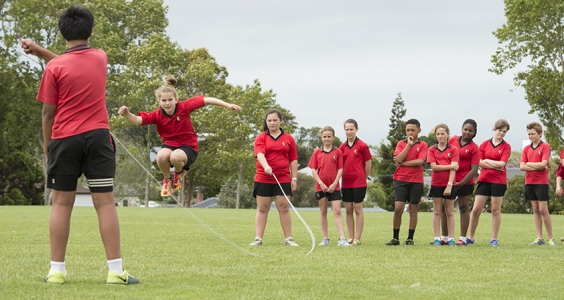
Thirty years ago, the Heart Foundation launched an exciting free programme called Jump Rope For Heart – Taura Peke mo te Manawa Ora. Their vision was twofold: to encourage physical activity in education settings and raise funds to support their vital work.
This important charity works to stop people dying prematurely of heart disease – New Zealand’s biggest single killer. The Heart Foundation is committed to promoting heart health by funding world-leading research, promoting healthy lifestyles and advancing cardiac care. Jump Rope For Heart is just one of its many successful programmes.
More than 2.4 million Kiwi kids have hopped, skipped and jumped with Jump Rope For Heart since the programme was launched in 1985. The Heart Foundation wants your students to join that growing number and experience the thrill of taking part in a Skip-a-thon.
To celebrate turning 30 years old, the Heart Foundation is thrilled to be offering a 50% rebate of total funds raised to all schools which sign up to Jump Rope in 2015. That means you can opt for a rebate of half of the money your school raises. Of course, you’ll be supporting the Heart Foundation’s life-saving work at the same time.
AIMING TO STAY FIT
The programme’s success is thanks to schools like St Joseph’s Primary and Intermediate in Oamaru, which holds a Skip-a-thon every two years. The 236-pupil school first joined the Jump Rope initiative in 1987 and has been holding a Skip-a-thon every two years since.
Tina Souness and Jan Plieger, two staff members, told us what inspires the school to get behind Jump Rope For Heart.
Tina, the school’s sports coordinator, says the main reason the school supports Jump Rope For Heart is to “keep the kids fit”. All the children, from new entrants upwards, love the challenge and throw themselves into it with enthusiasm.
“Kids are not as active today as they were years ago and we all knew how to skip [then] but some children now don’t know basic skipping and, if they do, can only manage a few simple skips.”
Jan also says she’s noticed a lower level of fitness among children these days. “When I was a child, everyone walked or biked to school and spent their spare time playing actively,” she says. “Nowadays children have many more choices for leisure and these do not always include active play.”
Jan says the manuals are an excellent resource and very easy to follow. “For a busy classroom teacher, the progressions are all laid out and are sequential, building on skills that the children have gained in previous years. Children enjoy the Skip-a-thon at the end of the programme and this can be tailored to fit into a morning or afternoon or longer.”
Jan describes skipping as a health-building exercise. “Jump Rope For Heart is still very relevant in today’s society and can be very beneficial in raising fitness levels.”
TIPS FOR A WINNING FORMULA
Running any new programme can be a challenge for schools, so getting a few tips from a seasoned coordinator like Deb Upchurch can be helpful.
Deb, who has been a teacher at Waiheke Island’s Te Huruhi Primary School since 1986, helps to coordinate the school’s Jump Rope For Heart programme.
She says schools need to set their Skip-a-thon date at least six weeks in advance, to allow enough time to start teaching skipping skills to pupils during their PE time. The Jump Rope For Heart resources, such as books, posters and ropes, are “invaluable”.
“I always start with individual skills, teaching the children how to hold the rope, and how to stop correctly. These skills take two to three weeks to teach.”
All children have to take part in Jump Rope but very few of them need persuading, Deb explains.
“Most children are excited to learn how to skip. Of course, there are always going to be uncoordinated ones who find it difficult but with time, practice and encouragement most kids can master some kind of basic jump.”
Once the children have mastered the art of skipping, they are taught paired skipping skills. Deb says they try to pair children with someone of the same height and skill level to make it easier. Finally, they teach group skipping skills to the children. “Most children love group skipping and all kids can jump over a wriggly rope or run through a turning one,” she says.
Two weeks before the Skip-a-thon, sponsorship forms are sent home with every child. On Skip-a-thon day the children are divided into senior, middle and junior syndicates. “The seniors go out first; one child starts for their group and does individual skipping for a few minutes. Then the lead teacher blows the whistle and the next child takes a turn. Soon the middle and junior schools join in,” Deb says. “After a while bedlam ensues and children are skipping everywhere!”
The school makes sure all sponsorship money is collected within two weeks of the Skip-a-thon and, once it receives its 25% rebate, the money is spent buying new PE gear. The school raised more than $6000 in its Skip-a-thon for the Heart Foundation last year!
It is clear that Te Huruhi has found a winning formula for its Jump Rope For Heart programme. We hope this helps your school to find one too.
Celebrate Jump Rope For Heart’s 30th birthday by registering today at www.heartfoundation.org.nz/jrfhschools*
*conditions of registration apply

